


Page 8 - hypertension_newsletter (5)
P. 8
REFLECTIONS                                                                                                                 rtensio n
Hypertension Global Newsletter #2                                                                                          Hype
                                                                                                                           Hype
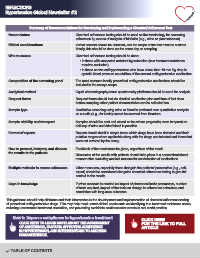
                     Summary of Recommendations for Developing and Implementing a Chemical Adherence Test
                                                                                                                            n oisnetr
Nomenclature                            Chemical adherence testing should be used as the terminology for assessing
                                        adherence by means of analysis of biofluids (e.g., urine or plasma/serum).

Ethical considerations                  Verbal consent should be obtained, and the scope of the test must be outlined.
                                        Ideally, this should be done on the same day as sampling.

Who to screen                           Chemical adherence testing should be done:

                                           • In those with suspected resistant hypertension (true treatment resistance
                                             requires exclusion)

                                           • In those on two antihypertensives who have a less than 10 mm Hg drop in
                                             systolic blood pressure on addition of the second antihypertensive medication

Composition of the screening panel      The most common locally prescribed antihypertensive medications should be
                                        included in the assays scope.

Analytical method                       Liquid chromatography-mass spectrometry platforms should be used for analysis.

Request forms                           Request forms should include detailed medication plan and time of last dose
                                        before sampling; other patient characteristics can be collected too.

Sample type                             Qualitative screening using urine or blood is preferred over quantitative analysis
                                        as cut-offs (e.g., for Cmin) cannot be sourced from literature.

Sample stability and transport          Samples should be sent and stored on ice where pragmatic; room temperature
                                        delivery of urine and dried blood is possible.

Format of reports                       Reports should detail in simple terms which drugs have been detected and their
                                        putative ranges where applicable along with the drugs not detected and those that
                                        were not covered by the assay.

How to present, interpret, and discuss  Feedback of the result must be given, regardless of the result.
the results to the patients
                                        Discussion of the results with patients should take place in a nonconfrontational
                                        manner after excluding medical reasons for nondetection of medications.

Multiple methods to assess adherence    Other measures, especially those that gain the patients’ perspective (e.g., self-
                                        report) should be considered alongside chemical adherence testing to give full
                                        context to the results.

Gaps in knowledge                       Further research is needed on impact of pharmacokinetic parameters, number
                                        of tests required, impact of the tests on change in adherence behaviour, and
                                        correlation with long-term outcomes.

This guidance should help clinicians and their laboratories in the development and implementation of chemical adherence testing
of prescribed antihypertensive drugs. This may help meet unmet clinical needs such as identifying true treatment resistance cases,
reducing unwarranted treatment escalation, and preventing avoidable cardiovascular events in real world practice.

How to improve compliance to hypertension treatment  CLICK HERE
                                                     FOR THE LINK TO FULL
     CLICK HERE TO LEARN MORE ABOUT THE ASSESSMENT   ARTICLE
     OF ADHERENCE, FACTORS AFFECTING ADHERENCE
     IN HYPERTENSION, AND INTERVENTIONS TO ADDRESS
     NONADHERENCE.

TABLE OF CONTENTS

